
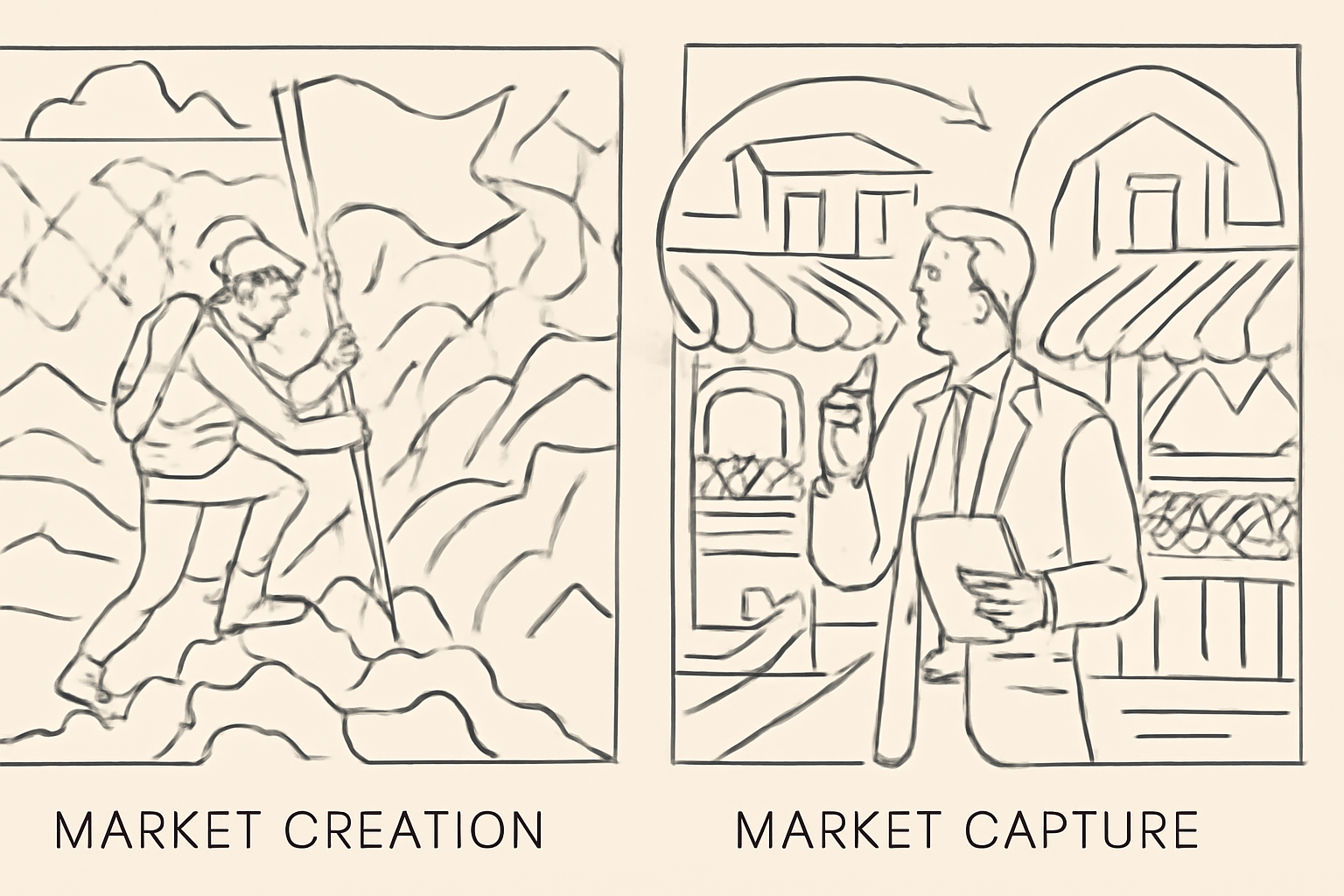
Market creation and market capture are two distinct strategic approaches that businesses utilize to achieve growth and enhance their competitive positions.
Market creation refers to the innovative process of developing new markets where none previously existed. This strategy involves the identification of unaddressed or latent consumer needs and the provision of entirely new products or services that fulfill those needs. The objective is to redefine the boundaries of an industry by pursuing new opportunities, which often leads to the disruption of existing markets. Market creation requires a deep understanding of emerging consumer trends, technological advancements, and the ability to think creatively about customer value propositions.
In contrast, market capture focuses on increasing a company’s share within existing markets. This strategy is typically characterized by competitive positioning, operational efficiencies, cost leadership, and differentiation of products or services to provide superior value compared to competitors. The aim is to capitalize on established markets by enhancing product offerings, improving service delivery, and optimizing distribution channels. Successfully capturing market share requires a keen awareness of competitors' strategies, a strong market presence, and the ability to swiftly adapt to market dynamics.
While market creation is fundamentally about pioneering new spaces within the business landscape, market capture involves optimizing and potentially expanding within already defined market domains. Companies may choose one strategy over the other based on their core competencies, resource capabilities, and strategic objectives. Combining elements of both strategies can sometimes lead to sustainable growth by synergizing innovation with strategic positioning in established markets.